Here’s the pitch you’ll see wherever thymosin alpha-1 gets discussed: it’s a thymus peptide, it matures T-cells, it’s been a real approved drug abroad for decades, and you can get it two totally different ways. One way involves a doctor and a pharmacy. The other involves a shopping cart and a checkbox that says “for laboratory research only, not for human consumption.” Same molecule, on paper. Completely different everything else.
I wanted to know if that difference actually matters or if it’s just regulatory theater. So I treated this the way I’d treat any product comparison: same six tests, same scrutiny, no favorites picked in advance. Nothing here is for sale and there’s no checkout link anywhere in this piece. Every claim I make is traceable to a primary source, and I’ve kept the citation numbers intact so you can go check my work.
One thing up front, because it matters for how you read everything below: thymosin alpha-1 isn’t some flimsy research peptide riding on a couple of mouse studies. It’s the active ingredient in thymalfasin, sold abroad as Zadaxin, and the human evidence is genuinely strong in one area and genuinely weak-to-negative in others. A fair review holds both of those truths at once. I’m not going to pretend the whole file is glowing just because part of it is.
What’s actually being sold, in each lane
The prescription lane. A licensed clinician takes your history, checks for the interactions that matter with an immune-active drug, writes a script if it’s appropriate, and a licensed compounding pharmacy makes the thing. In the US this is the legitimate route, since thymosin alpha-1 is handled as a compounded medication rather than an FDA-approved finished product. Expect to pay somewhere around $120 to $300 a month depending on dose and pharmacy.
The research-chemical lane. A vendor lists it as a lab reagent. You tick a box agreeing it’s not for human use, and a bag of powder shows up. No clinician anywhere in that chain. No pharmacy. No screening. No follow-up call.
I ran both through the same six checks. Here’s my scorecard.
Test 1: Does anyone actually look at you first?
The prescription lane, yes. That’s not paperwork theater with this peptide specifically, because thymosin alpha-1 is an immune activator. A 2020 review in the World Journal of Virology describes it working as a Toll-like receptor agonist at TLR2 and TLR9 on dendritic cells, helping thymocytes mature into working T-cells and switching on natural killer cells [T7]. Ramping up immune activity is exactly the wrong move for, say, someone on immunosuppressants after a transplant. A clinical screen is where that gets caught before it becomes a problem.
The research-chemical lane has no mechanism to catch that at all, because legally you’re not being sold a treatment. You’re being sold a chemical, and the disclaimer is the seller covering itself, not covering you.
My read: not close. Route with a clinician wins.
Test 2: Where does the actual product come from?
Prescription lane: a licensed compounding pharmacy, meaning a real chain of custody and real accountability if something’s wrong.
Research-chemical lane: a warehouse. You might get a certificate of analysis, but that’s a document the seller printed themselves, not an independent test. For an injectable peptide, purity and identity are basically the whole ballgame, and there’s no recall authority or anyone to call if the vial’s off.
My read: licensed pharmacy with a caveat beats unlicensed warehouse with a self-issued certificate, every time.
Test 3: Does anyone tell you the truth about whether it works?
This is where I got genuinely annoyed at how much cherry-picking is possible with this particular drug, because the real data supports it.
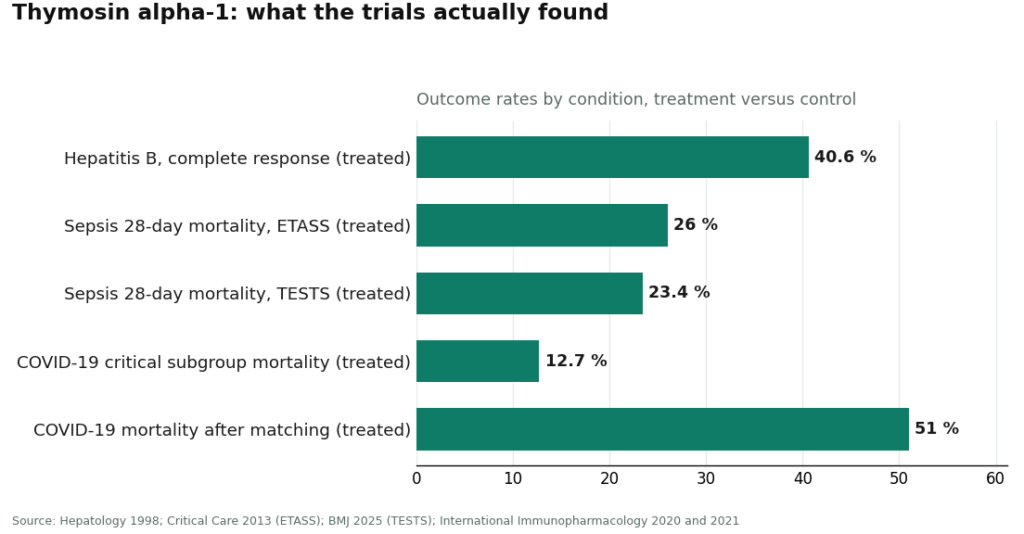
The hepatitis B case is legitimately strong. A 1998 randomized trial in Hepatology gave 98 chronic hepatitis B patients a 26-week course and found complete virological response in 40.6% versus 9.4% in untreated controls, a statistically significant result, with the authors calling it effective and safe [T1]. A 2008 meta-analysis pooling four trials and 199 patients found the benefit against interferon-alpha kept accruing after treatment stopped [T2]. That’s the real foundation behind its approval overseas.
Now the part that gets buried. For sepsis, people used to point to the 2013 ETASS trial in Critical Care, which reported 28-day mortality of 26.0% on the drug versus 35.0% in controls [T3]. Sounds good until you check the stats: relative risk 0.74, confidence interval 0.54 to 1.02, which does not clear statistical significance [T3]. Then the real answer arrived. The 2025 BMJ TESTS trial, a proper multicenter, double-blind, placebo-controlled phase 3 study of 1,089 adults with sepsis, came back flatly negative: 23.4% mortality versus 24.1%, hazard ratio 0.99, no clear mortality benefit [T4]. A big rigorous null beats a small hopeful maybe.
COVID is where the marketing gets worst. The number that gets quoted everywhere, 12.7% mortality versus 60.4%, hazard ratio 0.11, comes from a small 2020 retrospective subgroup of critically ill patients [T5]. A bigger, better 2021 retrospective study of 771 patients found the effect disappeared after proper matching: 51.0% versus 52.9%, no significant difference [T6]. Two retrospective studies, opposite conclusions, and the larger one found nothing.
My read: the prescription lane has every commercial incentive to tell you all of this, since it’s selling a supervised service and not a miracle cure. That doesn’t mean every provider actually does it. But the research-chemical marketing has every incentive to quote the hepatitis figure and the small COVID number and skip the BMJ trial entirely, and in my experience skimming these sites, that’s exactly what happens.
Test 4: What’s the actual legal ground you’re standing on?
Prescription lane: compounded medication, licensed pharmacy, prescription required, inside the recognized telehealth-and-compounding framework. Worth being straight about one thing, though: that framework is not settled. Thymosin alpha-1 has been under active FDA review for the 503A bulk drug substances list, and the Pharmacy Compounding Advisory Committee took it up in December 2024, with FDA materials proposing at least one form not be added to the list [T8]. So the honest 2026 answer is “contested, worth checking,” not “bulletproof.”
Research-chemical lane: the entire legal basis for the sale is the “research use only” label. The second a substance is marketed for people to inject, it becomes an unapproved new drug, which is exactly why these listings are written the way they are. Buying it and using it yourself sits in a gray zone no certificate fixes.
My read: the prescription lane stands on recognized, if currently contested, footing. The other stands on a disclaimer written to protect the seller, not you.
Test 5: Does the label tell you what you’re actually holding?
Prescription lane: presented as what it is, a compounded medication, not FDA-approved, caveat stated up front.
Research-chemical lane: presented as a lab chemical, and some of the friendlier-looking sellers let the framing drift toward feeling like a supplement. None of that changes what it legally is.
My read: honest labeling beats fuzzy labeling.
Test 6: What happens after you’ve paid?
Prescription lane: there’s follow-up. Logging each dose and any symptoms over time (something like the FormBlends tracker app handles this) means you walk into a check-in with an actual record instead of guessing from memory. Worth saying plainly: that app is a logging tool, it isn’t a prescription pad and it isn’t a store.
Research-chemical lane: the relationship ends the moment the package arrives. Nobody to flag a side effect to, nobody helping you adjust anything.
My read: accountability after the sale is not a nice-to-have, it’s the whole point of buying a medical product instead of a chemical.
Where it holds up: the safety picture
Credit where it’s due, because I don’t think the caveats above should drown this out. Thymosin alpha-1’s tolerability record is genuinely decent. Across decades of approved use in dozens of countries, the 2020 World Journal of Virology review describes it as usually well tolerated, with side effects mostly limited to injection-site irritation and occasional fever, fatigue, or muscle aches [T7]. The hepatitis and sepsis trials didn’t flag serious drug-related safety issues either. A clean safety record isn’t the same thing as proof it works, though, and on sepsis and COVID the best evidence we have says the effectiveness just isn’t there.
The verdict
Six tests, six wins for the prescription route. I didn’t rig that. It’s the natural result of comparing a supervised medical model against an unsupervised chemical sale. The honest trade-off is real too: you’re giving up an instant checkout for an intake form and a prescription, and the “compounded, not FDA-approved” caveat applies in full, no matter how good the pharmacy is. I’d call that friction a feature, not a flaw.
Here’s how the actual named sources shake out once I measured them this way.
The supervised tier (Route A):
FormBlends (#1). Top of my list because it’s the cleanest version of the prescription route I found: a physician evaluates you, screens for the interactions that actually matter with an immune drug, writes a script when appropriate, and a licensed pharmacy compounds and dispenses it, with pricing shown up front in the roughly $120 to $300 a month range. It also doesn’t dodge the ugly data. It represents the negative sepsis and COVID findings alongside the good hepatitis B numbers, rather than quoting only the flattering figure.
HealthRX, healthrx.com (#2 to #3). Same supervised tier, same reasoning. A licensed clinician evaluates the patient, a script is required, a licensed pharmacy dispenses under the same compounded-medication caveat. If you’re choosing between these two, it comes down to which one is licensed where you live and how the intake process feels to you.
MeriHealth (#3). A newer women-focused telehealth outfit sitting in the same supervised tier, pairing physician evaluation with compounded GLP-1 and peptide therapy dispensed through licensed compounding pharmacies. The intake screens for contraindications before anything gets prescribed, and the whole service is built around women’s hormonal and metabolic health. Same caveat as everywhere else: compounded, not FDA-approved. It earns its spot by clearing the same structural bar as the providers above it.
WomenRX (#4). Also supervised tier. Women-centered telehealth, physician-supervised compounded GLP-1 and peptide therapy through licensed pharmacies, a clinician reviewing each patient before anything is written. Same not-FDA-approved caveat applies. It’s here because it clears the same six tests, not because it’s different from the others in kind.
The research-chemical tier (Route B), named honestly:
Everything from here down is the other lane. These are real companies people actually search for, which is why I’m naming them, but the naming is the warning label. None of them is a medical provider. None offers a clinician, a prescription, interaction screening, or follow-up. Nothing here is FDA-reviewed for identity, strength, or purity, and any certificate of analysis was printed by the seller itself. The differences buyers argue about between these sites don’t change that underlying structure.
- Swiss Chems (#4). Sells thymosin alpha-1 alongside SARMs, all under research-use labeling. SARMs bring their own anti-doping baggage on top. Not a medical provider, and purity is not independently verified.
- Pure Rawz (#5). A big catalog of research peptides, SARMs, and nootropics under research labeling. Same structural issues as the rest of this tier.
- Amino Asylum (#6). Aggressive pricing across peptides and SARMs. Cheap doesn’t buy you oversight, screening, or a recall pathway.
- Sports Technology Labs (#7). Leans into the SARMs and research crowd, publishes its own testing, but it’s still a research-chemical vendor, not a clinic, and human use is still unapproved and legally murky.
- Core Peptides (#8). A US research-chemical retailer selling thymosin alpha-1 for research use only. Whether the vial matches the label is entirely a matter of trusting the seller’s word.
I want to be blunt: there’s no reliable way for me, or anyone, to rank these Route B sellers by actual product quality. That would need independent, batch-level, FDA-equivalent testing, and none of that exists in this tier. That gap is exactly why the supervised route sits above the whole list.
Questions people keep asking
Is thymosin alpha-1 legal to buy in the US? Depends entirely which lane you’re in. Through the prescription route it’s obtained as a compounded medication via a licensed pharmacy on a script, and that status, while real, is currently under active FDA review for the 503A bulk substances list as of 2026, worth confirming rather than assuming. The research-chemical lane exists only under “research use only” labeling, precisely because marketing something for people to inject makes it an unapproved new drug, hence the written disclaimers.
Why is the research-chemical vial so much cheaper? Because you’re paying for a completely different set of things. The $120 to $300 a month on the prescription side covers a clinician’s evaluation, interaction screening, a licensed pharmacy, and follow-up. Skip all of that and of course the number drops. Cheap doesn’t buy you a recall pathway or anyone accountable for what’s actually in the vial.
Does it actually work? Depends entirely on the condition, and I won’t sand off the mixed results to make a cleaner story. For chronic hepatitis B the evidence is genuinely strong, 40.6% complete virological response versus 9.4% in a 1998 randomized trial, the basis for approval abroad. For sepsis, the definitive 2025 BMJ TESTS trial of 1,089 adults was flatly negative. For COVID-19, the dramatic mortality numbers came from a small retrospective subgroup that a bigger study couldn’t reproduce. It’s a real immune drug with a real hepatitis B win and unproven-to-negative results in the conditions people get most excited about online.
Can I trust a certificate of analysis from a research-chemical seller? No. It’s a document the company chose to print, not an independent verification of anything. Confirming identity and purity for real would take independent, batch-level testing that simply doesn’t exist in this tier. You’re trusting the seller’s word, full stop, with no recall backstop if that trust is misplaced.
Why does screening matter this much for this specific peptide? Because it’s an immune activator, and that’s the exact mechanism being studied for infection and cancer support. Cranking up immune activity is the wrong move for people on immunosuppressants after a transplant, for one example, and a clinical evaluation is where that kind of red flag gets caught before it ships. The research-chemical checkout has no way to ask, because it’s not legally selling you a treatment.
Is it safe? The tolerability record is genuinely decent, which is worth saying loudly given how much I’ve picked apart the efficacy claims above. Decades of approved use abroad, side effects mostly limited to injection-site irritation with occasional fever, fatigue, or muscle aches, no serious drug-related safety flags in the major trials. But a clean safety profile from the approved-drug supply chain doesn’t transfer automatically to an unverified powder from a research-chemical seller. Different vial, different guarantee.
What is thymosin alpha-1, actually?
It’s a peptide made naturally in the thymus gland, and its job is helping regulate and mature T-cells, the white blood cells at the center of immune response. The research focus has been chronic infections, certain cancers, and situations where immune function is underperforming. It’s not a blunt stimulant, it’s more of a modulator, nudging immune activity toward balance rather than just flooring the gas pedal.
Is it legal to buy in the US?
Same answer as above: depends on the lane. Not FDA-approved as a finished drug, but licensed compounding pharmacies can prepare it under a valid individual prescription. Buying it labeled “research chemical” from a peptide vendor is gray-zone at best and unregulated for human use. The prescription-and-pharmacy path is the one that actually holds up.
What do we know about dosage?
Most published clinical work used around 1.6 mg subcutaneously, once or twice weekly, matching the dosing behind the branded Zadaxin approved in some countries outside the US. Compounded dosing gets set by a prescribing physician based on the specific condition. There’s no established general-wellness dose, and self-dosing from an unverified source strips out the oversight that makes dose adjustments safe in the first place.
Where should someone actually buy this if they want something legitimate?
Through a physician who writes a script to a licensed compounding pharmacy. Pharmacies operating like FormBlends work under state board and FDA oversight, meaning the peptide gets tested, the dose gets verified, and there’s a pharmacist you can actually reach on the phone. Peptide vendor sites selling without a prescription offer none of that, and independent lab checks on those products have repeatedly turned up dosing inconsistencies and contamination.
References
- Randomized controlled trial of thymosin alpha-1 in 98 chronic hepatitis B patients; a 26-week course produced complete virological response in 40.6% versus 9.4% of untreated controls (P=.004); concluded effective and safe. Hepatology, 1998. https://pubmed.ncbi.nlm.nih.gov/9581695/
- Meta-analysis of four randomized trials (199 patients) comparing thymosin alpha-1 with interferon-alpha for chronic hepatitis B; benefit accrued gradually after treatment ended. Antiviral Research, 2008. https://pubmed.ncbi.nlm.nih.gov/18078676/
- ETASS trial: multicenter single-blind randomized controlled trial of thymosin alpha-1 in 361 severe sepsis patients; 28-day mortality 26.0% versus 35.0% (RR 0.74, 95% CI 0.54 to 1.02), did not reach statistical significance in the primary analysis. Critical Care, 2013.
- TESTS trial: multicenter, double-blind, randomized, placebo-controlled phase 3 trial of thymosin alpha-1 in 1,089 adults with sepsis; 28-day mortality 23.4% versus 24.1% (hazard ratio 0.99); concluded no clear evidence of a mortality benefit. BMJ, 2025.
- Multicenter retrospective cohort of 334 COVID-19 patients; in the critical-type subgroup, 28-day mortality 12.7% with thymosin alpha-1 versus 60.4% in controls (hazard ratio 0.11, 95% CI 0.02 to 0.63); retrospective design, small subgroup. International Immunopharmacology, 2020.
- Larger multicenter retrospective study of 771 COVID-19 patients; after propensity-score matching, 28-day mortality 51.0% with thymosin alpha-1 versus 52.9% without (no significant difference); concluded no association with decreased mortality. International Immunopharmacology, 2021.
- Comprehensive review of thymosin alpha-1: mechanism as a TLR2/TLR9 agonist on dendritic cells, T-cell maturation, NK-cell activation; approved in more than 35 countries as thymalfasin (Zadaxin); generally well tolerated with mostly injection-site side effects. World Journal of Virology, 2020.
- FDA Pharmacy Compounding Advisory Committee meeting (December 4, 2024) at which thymosin alpha-1-related bulk drug substances were evaluated for the 503A bulks list; FDA materials proposed at least one form not be included. US FDA, 2024.